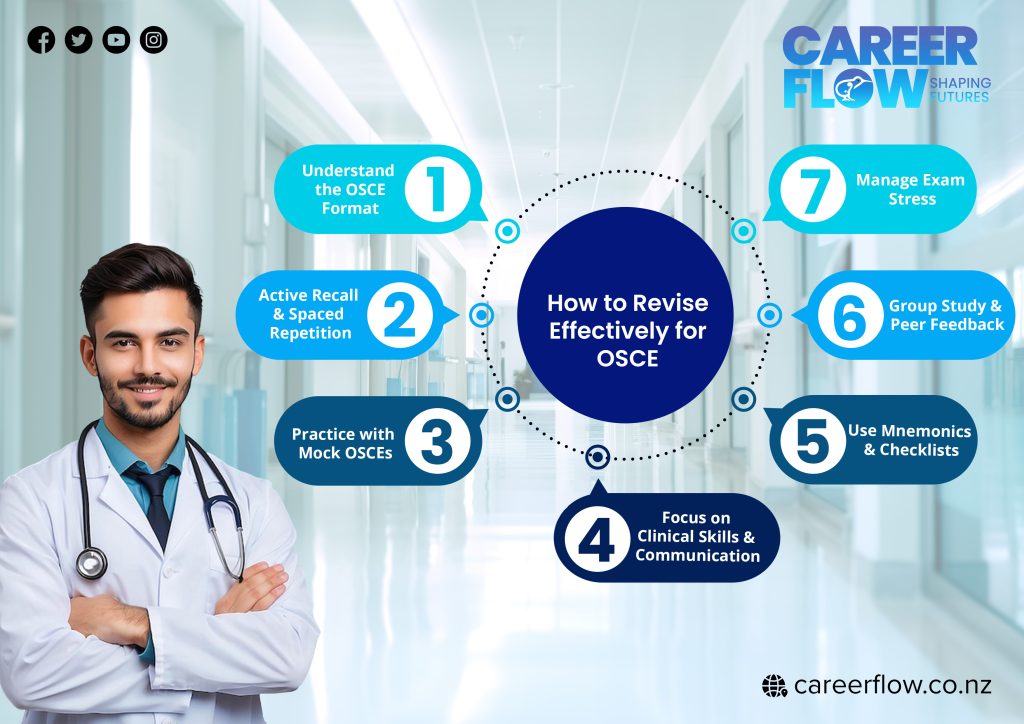
1. Understand the OSCE Format
Before diving into revision, familiarize yourself with the OSCE structure. Knowing the stations, time limits, and marking criteria will help you focus your preparation. Our expert trainers break down each station, ensuring you know exactly what to expect.
2. Active Recall & Spaced Repetition
Research shows that active recall (retrieving information from memory) and spaced repetition (reviewing material over increasing intervals) significantly improve retention. Instead of passively reading notes, test yourself regularly.
Use flashcards for key concepts.
Quiz yourself on clinical procedures.
Revisit challenging topics at spaced intervals.
3. Practice with Mock OSCEs
One of the most effective ways to prepare is through simulated OSCE exams. We provide realistic mock OSCEs with feedback from experienced nurses, helping you identify strengths and areas for improvement.
Time yourself to mimic exam pressure.
Record your performance to analyze body language and communication.
Get feedback from peers or mentors.
4. Focus on Clinical Skills & Communication
OSCE isn’t just about knowledge—it’s about demonstrating competence in a clinical setting.
Practice hands-on skills (e.g., wound dressing, injections) repeatedly.
Work on patient communication—use clear, empathetic language.
Follow a structured approach (e.g., ISBAR for handovers).
5. Use Mnemonics & Checklists
Complex procedures can be simplified with mnemonics and checklists. For example:
ABCDE (Airway, Breathing, Circulation, Disability, Exposure) for patient assessment.
SAMPLE (Symptoms, Allergies, Medications, Past medical history, Last meal, Events) for history-taking.
We provide customized checklists to ensure you don’t miss critical steps.
6. Group Study & Peer Feedback
Studying with peers can enhance learning through:
Role-playing different OSCE scenarios.
Peer assessments to gain new perspectives.
Discussing difficult cases collaboratively.
7. Manage Exam Stress
Stress can hinder performance, so incorporate relaxation techniques:
Deep breathing exercises before stations.
Positive visualization of success.
Adequate sleep and hydration in the days leading up to the exam.
Why Choose CareerFlow for OSCE Training?
As the best OSCE training center, CareerFlow offers:
✅ Expert-led coaching with real-time feedback.
✅ Personalized study plans tailored to your needs.
✅ High-quality mock OSCEs in a simulated environment.
✅ Proven success rates with past students.
Conclusion
Effective OSCE revision requires a mix of knowledge, practice, and confidence. By using evidence-based techniques like active recall, mock exams, and structured checklists, you’ll be well-prepared to excel.